Most businesses don’t question video production until it starts slowing them down. What begins as a manageable process for one campaign quickly turns into a bottleneck when content demand increases. More ads, more variations, and more campaigns expose the limits of traditional production.
That is when the comparison between AI video production and traditional shoots becomes practical. It is no longer about preference. It becomes about what actually supports business growth.
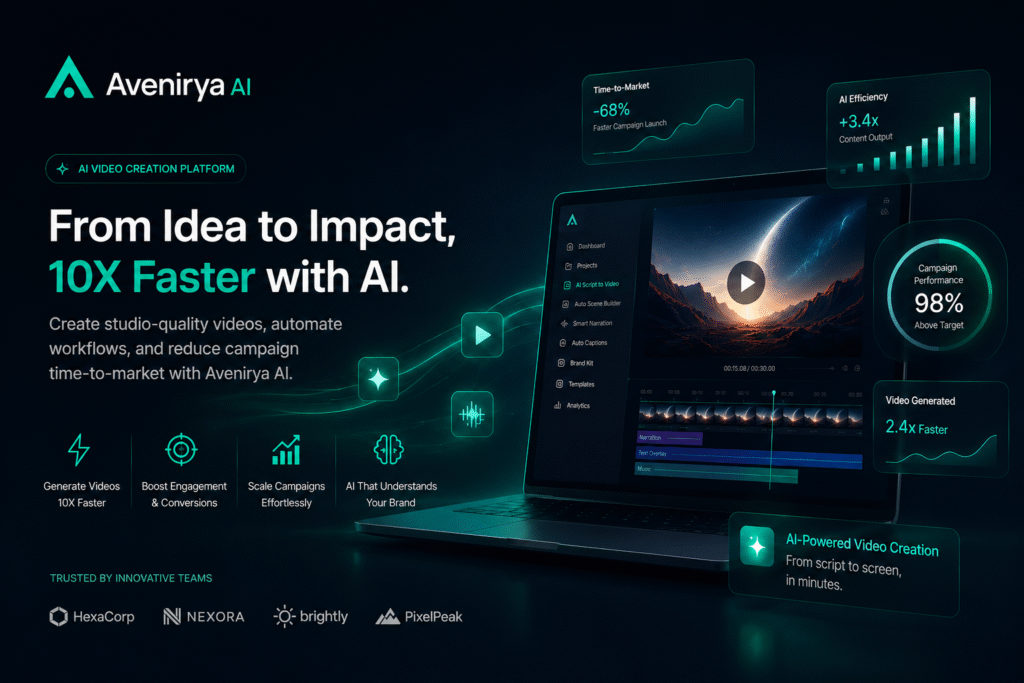
Avenirya.ai is built around this shift, offering a faster and more scalable way to create ad-ready content without the repeated effort of traditional workflows.
How Traditional Video Production Works in Practice
Traditional production is built around physical execution. Every video requires planning, shooting, editing, and revisions, all happening in sequence. While this works for one-off projects, it becomes difficult to manage when content needs to be produced consistently.
As demand increases, the same effort repeats for every new creative. Timelines remain fixed, revisions slow things down, and scaling becomes dependent on resources. This creates a system where content production cannot keep up with marketing needs.
How AI Video Production Changes the Model
AI video production removes the dependency on physical shoots and replaces it with a digital workflow. Instead of capturing footage, content is generated based on campaign requirements, making it easier to create and adjust creatives without restarting the process.
On Avenirya.ai, this includes AI UGC, product cinematics, and ad creatives that are already structured for campaign use. The workflow becomes shorter, more flexible, and easier to repeat at scale.
Cost Comparison: One-Time vs Repeatable
In traditional production, costs are tied to each individual video. Every variation requires new planning, execution, and editing. As a result, costs increase with every additional creative.
AI video production shifts this structure.
The real difference is not just lower cost—it is how cost behaves over time. Once the workflow becomes digital, businesses can generate multiple variations without repeating the same level of effort. This makes scaling more predictable and more efficient.
Speed Comparison: Fixed Timelines vs Fast Turnaround
Speed is where the difference becomes more visible in daily operations. Traditional production follows fixed timelines, where even minor changes can delay campaigns.
AI video production removes much of that delay by enabling faster content creation. Businesses can move from idea to execution without waiting for long production cycles, which directly impacts how quickly campaigns can be launched.
Scalability Comparison: Limited vs Expandable
Scaling traditional production means increasing effort, coordination, and cost. Each new campaign or variation adds complexity to the process.
With AI production, scaling becomes less dependent on resources. Businesses can create multiple variations, run parallel campaigns, and maintain consistent output without repeating the same production cycle.
This changes how content supports growth.
The Decision That Matters
This is not about replacing traditional production completely. It is about choosing the right system for the role content plays in your business.
If video is occasional, traditional production can still work. But if video is central to your marketing—ads, campaigns, and testing—then delays, repeated costs, and limited scalability become real problems.
That is where AI video production becomes the better fit.
Where Avenirya.ai Fits In
Avenirya.ai is designed for businesses that need consistent, scalable, and fast video output. It focuses on AI UGC, product cinematics, and high-converting ad creatives built for campaign use.
With faster turnaround and a structured workflow, it allows teams to move away from repeated production cycles and toward continuous content creation. You can explore how this works in practice on Avenirya.ai.
Final Thought
The difference between AI video production and traditional production is not just how videos are created. It is how businesses operate.
When production is slow and repetitive, marketing slows down with it. When production becomes faster and scalable, marketing becomes more adaptive.
That is the real shift.